4 Chinese New Year Health Traditions That Actually Work
Chinese New Year, or the Spring Festival, is more than just fireworks, dragon costumes, and red lanterns. Just as Westerners make “New Year’s Resolutions,” so the Chinese New Year is also a time of renewal and cleansing with special focus on health. It is time to restore balance, reflect and reset the mind and body.
From red envelopes to eating foods associated with prosperity and good health, Chinese new year health traditions are all about setting you up for the year ahead. Whether you’re already familiar with some of the practices or you’re interested in trying them out, these traditions can help bring good luck, good health, and good fortune in 2026.
Here are some of the best Chinese new year health traditions to know for 2026:
When is Chinese New Year 2026?
Chinese New Year 2026 falls on 17th February (Tuesday) and lasts until 3rd March. It marks the beginning of the Year of the Horse.
The Horse is the seventh animal in the Chinese zodiac and is traditionally associated with energy, independence, and charisma. 2026 is a Fire Horse year, linking the sign to intensity, drive, and outward momentum.
The last Year of the Horse was 2014.
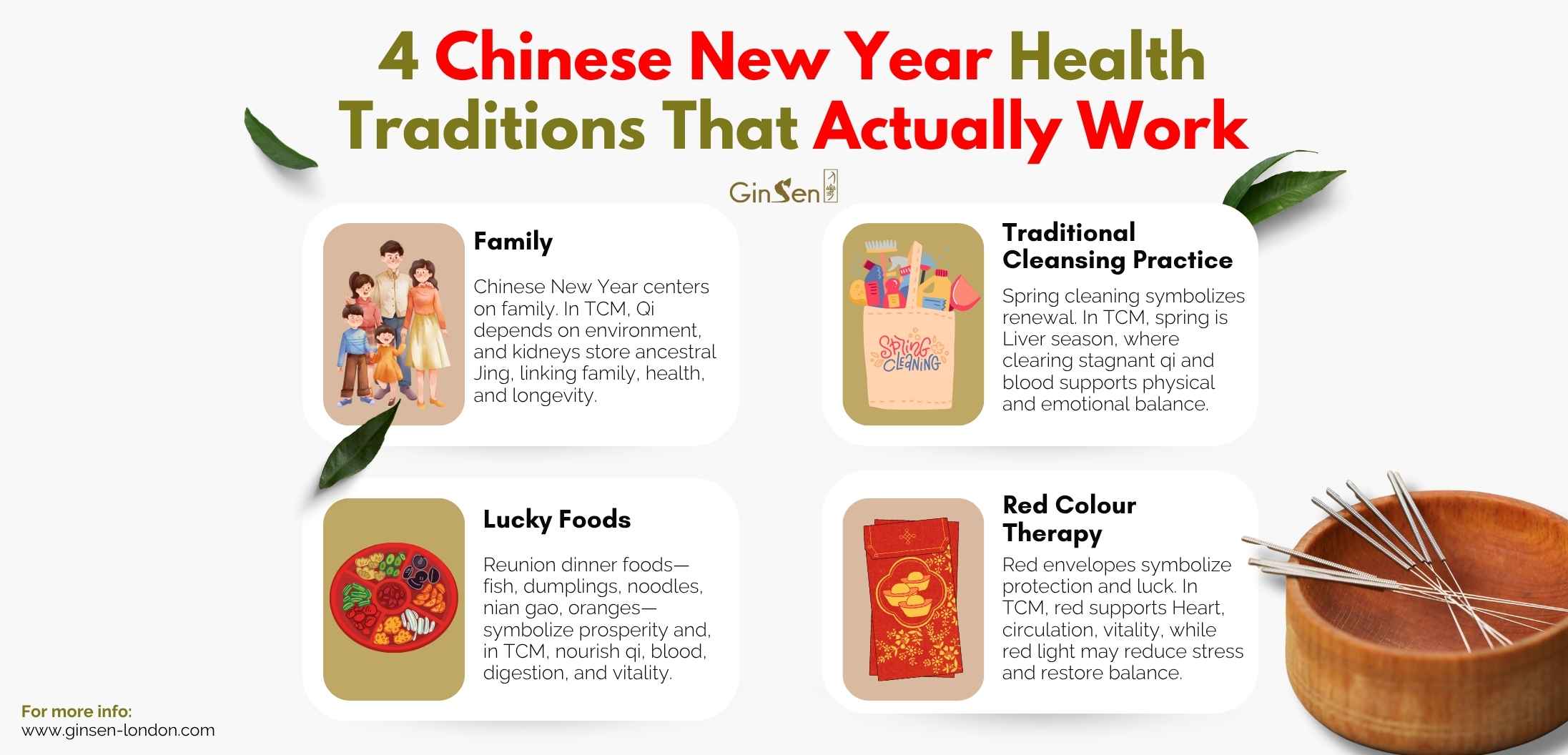
1. Chinese New Year Is All About Family
Chinese New Year isn’t just a time to spend money and celebrate. The main focus is on spending time with family.
This idea is deeply ingrained in Traditional Chinese Medicine. Qi, the life energy within your body, doesn’t exist in isolation. It forms and moves depending on your environment. That includes, who you live with, who raised you, who stresses you, who supports you.
Kidneys are linked to family and ancestry
In Traditional Chinese Medicine, family gatherings during the New Year are deeply connected to health, as the Kidneys associated with ancestry and longevity store Jing, the essence inherited from your parents, and so shared (in full or in part) with all members of your family.
2. Traditional Cleansing Practice for New Year Spring Clean
Spring cleaning isn’t about dust, it is symbolic, representing the release of what no longer serves us from the previous year. While cleaning the home is believed to sweep away ill fortune, Traditional Chinese Medicine teaches that cleansing must also occur internally.
Spring is considered the Liver season in TCM
If the body becomes stagnant, stagnant Blood or qi ,it affects everything, eventually manifesting as symptoms both physically and emotionally. That’s why spring is the Liver season in TCM. The liver is regarded as the centre of cleansing. It cleans and restores the Blood just as it does with qi.

3. Lucky Foods and Their Medicinal Properties
Chinese New Year is often celebrated with a reunion dinner, when family members gather. A big part of the dinner is a communal hot pot a culinary symbol of coming together.
Alongside the main dishes, there are several lucky foods associated with the Chinese New Year. Some of these have medicinal properties.
Common examples include:
- Fish
Fish is either eaten or displayed on the eve of the Chinese New Year. The name of the fish in Chinese sounds like “surpluses,” and so the fish is a symbol of prosperity.
It’s also a warm, nourishing food that supports the Kidneys and helps build Jing, the body’s essential vitality. It also strengthens Blood and qi, making it especially beneficial after the depletion of winter.
- Dumplings
New Year’s dumplings come in several varieties. Jiaozi is a common northern Chinese dumpling. Different fillings are added to represent good fortune for example, coins, dried dates, or candy. Medicinally, dumplings are grounding and nourishing, supporting digestion and helping anchor qi.
Jau gok is another type of dumpling popular among Cantonese families. It’s shaped to resemble a sycee, the old Chinese ingots, and represents prosperity. Jau gok is a warm, nourishing, and hearty dish, often made with pork or Chinese black mushrooms. It helps dispel cold and dampness, promote circulation, relieve stagnation that settles during the winter months.
- Noodles
Chinese New Year noodles aren’t like the ones you find the rest of the year. They’re left uncut, making them as long as they can. The practice represents longevity and a long life. In TCM, noodles especially when served warm in broth help support the Spleen and Stomach. They provide sustained nourishment and promote steady qi flow, reinforcing vitality for the year ahead.
- Nian Gao
Nian Gao is the traditional New Year dessert in eastern China. Its name sounds like “a more prosperous year.” Made from rice flour, wheat starch, salt, water, and sugar, it’s a delicious pudding, perfect for welcoming in the New Year. Nian gao is considered strengthening and tonifying, supporting the Spleen and providing slow, lasting energy.
- Oranges
Oranges, especially mandarin oranges, are popular during the Chinese New Year. The name sounds like “luck” or “success” in certain dialects. Like many Chinese new year health traditions, it’s about increasing one’s fortune in the year ahead. But oranges are also rich in Vitamin C and can help rebuild and move qi within the body, relieve mild stagnation.
4. Red Colour Therapy in TCM
Red envelopes are everywhere during the Chinese New Year. It’s one of the oldest traditions. Often, they contain gifts of money usually an even amount, as odd is considered ill luck.
The name of these envelopes (yasuiqian) literally means “money to suppress evil spirits.” Red is associated with the Heart system, which governs Blood circulation, emotional balance, and the Shen, or spirit. As a warming, yang color, red is believed to invigorate circulation, dispel cold, and restore vitality after the stillness of winter.
Alongside these practices, red light is everywhere during the New Year. Red lanterns hang across Chinese cities, marking the holiday. Red light has gained attention for its potential to reduce stress and inflammation within the body, restoring balance. Just another part of bringing fortune for the year ahead.
* These statements have not been evaluated by the Food and Drug Administration. This information is not intended to diagnose, treat, cure, or prevent any disease. We can’t guarantee the treatment result, as the symptoms of conditions are unpredictable and vary greatly from person to person. The treatment length and recovery time also varies for individual. Please visit our clinics website: GinSen where a specialists will discuss your care and provide a consultation, and the treatment will be designed to meet your individual needs.